Saturday, August 22, 2009
Kicking Fall Off with a Healthy Bang!
Pack a healthy lunch- Taking 5 mins in the morning or the night before to make your own lunch ensures you save some money while controlling portions, taste, and health needs.
Stretch- Wake up 3 mins early, stretch out, do some general strength exercises to get your going.
Lunchtime jolt- Before you leave for lunch, stretch again, do another set of general strength exercises to get you ready for a great lunch.
Relax- Take an extra minute in the shower to just relax and process your day. Use the hot water to wash the stress away.
Monday, July 27, 2009
Wellness2Go's 80's Throw Back Pool Party

Thursday, July 23, 2009
Now walk it out....
If a daily fitness walk could be put in a pill, it would be one of the most popular prescriptions in the world. It has so many health benefits. Walking can reduce the risk of many diseases — from heart attack and stroke to hip fracture and glaucoma. These may sound like claims on a bottle of snake oil, but they're backed by major research. Walking requires no prescription, the risk of side effects is very low, and the benefits are numerous:
Managing your weight. Combined with healthy eating, physical activity is key to any plan for long-lasting weight control. Keeping your weight within healthy limits can lower your risks of type 2 diabetes, heart disease, stroke, cancer, sleep apnea, and osteoarthritis.
Controlling your blood pressure. Physical activity strengthens the heart so it can pump more blood with less effort and with less pressure on the arteries. Staying fit is just as effective as some medications in keeping down blood pressure levels.
Decreasing your risk of heart attack. Exercise such as brisk walking for three hours a week — or just half an hour a day — is associated with a 30% to 40% lower risk of heart disease in women. (Based on the 20-year Nurses' Health Study of 72,000 female nurses.)
Boosting "good" cholesterol – the level of high-density lipoproteins (HDL). Physical activity helps reduce low-density lipoproteins (LDL or "bad" cholesterol) in the blood, which can cause plaque buildup along the artery walls — a major cause of heart attacks.
Lowering your risk of stroke. Regular, moderate exercise equivalent to brisk walking for an hour a day, five days a week, can cut the risk of stroke in half, according to a Harvard study of more than 11,000 men.
Reducing your risk of breast cancer and type 2 diabetes. The Nurses' Health Study also links regular activity to risk reductions for both these diseases. In another study, people at high risk of diabetes cut their risk in half by combining consistent exercise like walking with lower fat intake and a 5% to 7% weight loss.
Avoiding your need for gallstone surgery. Regular walking or other physical activity lowers the risk of needing gallstone surgery by 20% to 31%, found a Harvard study of more than 60,000 women ages 40 to 65.
Protecting against hip fracture. Consistent activity diminishes the risk of hip fracture, concludes a study of more than 30,000 men and women ages 20 to 93.
The list goes on and on. Many other studies indicate a daily brisk walk also can help:
- Prevent depression, colon cancer, constipation, osteoporosis, and impotence
- Lengthen lifespan
- Lower stress levels
- Relieve arthritis and back pain
- Strengthen muscles, bones, and joints
- Improve sleep
- Elevate overall mood and sense of well-being.
Keep it Steady
A steady routine is the most important factor in getting the most out of your exercise program. Walking for at least 30 minutes a day, 5 or more days a week is recommended.
Use these tips to keep you on track:
- During your walks, you should be able to maintain a conversation. If you're breathing too lightly, increase your pace. If you can't catch your breath, slow it down.
- Walk around the local area after lunch or dedicate 15 minutes to walking up and down stairs. Climbing is an excellent way to strengthen your heart.
- At night, trade a half hour of TV for a brisk stroll around the block. Take a friend with you for company or get the whole family involved.
The Best Medicine
Any amount of walking is good, but for the best health results, set a brisk pace and walk for 30 minutes at least 5 times a week. Be sure to check with your doctor on the level of exercise that's best for you.
Tuesday, July 14, 2009
You are now free to "move it" about the cabin!
Squeeze a tennis ball, a racquetball or even a pair of socks with your hands until they're tired.
- Step2
Keep the balls of your feet planted and raise your legs using your calf muscles. If this is too easy, place your carry-on bag on your knees. Continue until tired.
- Step3
Plant your heels firmly and raise your toes as high as possible. Hold for five seconds, and relax. Repeat until tired.
- Step4
Place your hands on your armrests and raise your knees slowly (together is harder than one at a time) toward your chin. Lower them slowly. Repeat until tired.
- Step5
Cross your legs. Rotate the dangling foot in as wide a circle as possible. Continue until tired.
- Step6
Stretch your neck by keeping your chin close to your throat and tilting your head forward. Roll your head from one shoulder to the other, but avoid rotating it backward.
- Step7
Flex your trapezius muscles by doing shoulder hunches. Lower your shoulders, and then raise them up toward your ears into a shrug. Hold for five seconds. Continue until tired.
- Step8
Arch your torso gently backward and forward like a cat.
- Step9
Flex your gluteus muscles and hold for as long as possible. Squeezing your rear like this may occasion strange glances, but these muscles are the biggest in the human body and need to be exercised, too.
Try moving...literally
Moving activities that involve packing and unpacking boxes engage the arms, shoulders, abdominals and chest muscles in constant movement. Larger objects will require more energy and strength to lift and pack, and this can burn extra calories per hour. This can turn into a mild to moderate aerobic activity or workout.
Friday, July 10, 2009
Never give up! Never surrender!
Barrier: I don't have enough time to exercise
Setting aside time to exercise can be a challenge. Use a little creativity to get the most out of your time.
- Squeeze in a few 10-minute walks throughout the day. If you don't have time for a full workout, don't sweat it. Shorter spurts of exercise spaced throughout the day offer benefits, too.
- Get up earlier. If your days are packed and the evening hours are just as hectic, get up 30 minutes earlier twice a week to exercise. Once you've adjusted to early-morning workouts, add another day or two to the routine.
- Claim the back row of the parking lot as your own. Or park a few blocks away and walk quickly to your destination.
- Rethink your rituals. Your weekly Saturday matinee with the kids or your best friend could be reborn as your weekly Saturday bike ride, rock-climbing lesson or trip to the pool.
Barrier: Exercise is boring
It's natural to grow weary of a repetitive workout day after day, especially when you're going it alone. But exercise doesn't have to be boring.
- Think of it as an activity. If you choose activities you enjoy, you're more likely to stay interested. Remember, anything that gets you moving counts.
- Vary the routine. Rotate among several activities — such as walking, swimming and cycling — to keep you on your toes while conditioning different muscle groups.
- Join forces with friends, relatives, neighbors or co-workers. Enjoy the camaraderie, and offer encouragement to one another when the going gets tough.
- Check out exercise classes or sports leagues at a recreation center or health club. Learn new skills while getting a great workout.
Barrier: I'm self-conscious about how I look when I exercise
Don't get down on yourself! Remind yourself what a great favor you're doing for your cardiovascular health, or focus on how much stronger you feel after a workout. Praise yourself for improving your stamina and making a commitment to lifelong fitness.
If you're still uncomfortable exercising in the presence of others, go solo at first. Try an exercise video or an activity-oriented video game. Consider investing in a stationary bicycle, treadmill, stair-climbing machine or other piece of home exercise equipment. As you become healthier and more at ease with exercising, your self-confidence is likely to improve as well.
Barrier: I'm too tired to exercise after working all day
No energy to exercise? Without exercise, you'll have no energy. It's a vicious cycle. But breaking the cycle with physical activity is one of the best gifts you can give yourself.
- Try a morning dose of exercise. Remember the suggestion to get up 30 minutes earlier to exercise? Hop on the treadmill or stationary bicycle while you listen to the radio or watch the morning news. Or step outside for a brisk walk.
- Make lunchtime count. Keep a pair of walking shoes at your desk, and take a brisk walk during your lunch break.
- Be prepared. Put workout clothes on top of your dresser, socks and all. Keep a full water bottle in the fridge. Have an exercise video queued up and ready to go when you get home at night.
- Hit the hay earlier. Running on empty is no way to face a full day. Go to bed earlier to make sure you're getting enough sleep.
Barrier: I'm too lazy to exercise
If the mere thought of a morning jog makes you tired, try these thoughts on for size:
- Set realistic expectations. If your mental bar is too high, you might give up without even trying. Start with a walk around the block. Don't give up if you feel worn out. Take another walk around the block tomorrow. Keep it up, and eventually you'll no longer feel worn out. That's progress!
- Work with your nature, not against it. Plan physical activity for times of the day when you tend to feel more energetic — or at least not quite so lazy.
- Schedule exercise as you would schedule an important meeting or appointment. Block off times for physical activity, and make sure your friends and family are aware of your commitment. Ask for their encouragement and support.
Barrier: I'm not athletic
Natural athletic ability isn't a prerequisite to physical activity. Try something simple, such as a daily walk. Better yet, team up with friends who are in the same boat. Have fun while helping each other work out. Don't worry about becoming a superstar athlete or joining the hard-bodied athletes at the fitness club. Simply focus on the positive changes you're making to your body and mind.
Barrier: I've tried to exercise in the past and failed
Don't throw in the towel! You can't see it when you lower your cholesterol or reduce your risk of diabetes, but that doesn't mean you aren't doing yourself a great favor. Re-evaluate what went wrong, and learn from your mistakes.
- Pace yourself. Start small and build up to more-intense workouts later, when your body is ready.
- Set realistic goals. Don't promise yourself you're going to work out for an hour every day, and then get down on yourself when you fall short. Stick with goals you can more easily achieve, such as exercising 20 minutes a day, three days a week for the first month.
- Remember why you're exercising. Use your personal fitness goals as motivation — and reward yourself as you meet your goals.
Wednesday, July 8, 2009
Pilates...more than meets the eyes
If want a long, lean look without bulky muscles, but with all the strength. Would you like to build strength and endurance without getting the muscle man look? If so, pilates may be just what you have been searching for.
There's a reason that pilates is the exercise of choice for gymnasts and professional dancers. Most conventional workouts tend to create bulky muscle. Why is this? In most workouts, the emphasis is placed on repetition and building strong muscles.
This causes already-strong (think: big) muscles to get even strong, and thus bigger. Pilates does not rely on frequent repetition, and thus no overgrown muscles. Pilates focuses on the whole body, not just on sections of muscles.
2. Increases the Strength of Stabilizer Muscles
There are many benefits that one can achieve through a proper use of the pilates program. One of the most significant points of the pilates program is it's ability to increase the strength of stabilizer muscles that may not commonly be worked out in a standard exercise program.
Also, since pilates stresses the use of graceful and fluid movements, it can be a great way to get a better sense of the kinesthetics ofyour body. The sense of body that you can achieve through pilates is quite significant, and many find that they are better able to balance themselves regardless of the position that they are in.
3. A Mind-Body Workout That Strengthens Your Whole Body
Another one of the benefits of Pilates is that it engages the mind and enhances body awareness. Like yoga, tai chi, and Asian martial arts, Pilates is not just a workout for your body. Joseph H. Pilates studied yoga, martial arts, and other ancient mind-body activities and included a strong philosophical foundation into the practice of Pilates.
Pilates not only helps tone your body, but your mind and spirit as well. The smooth, precise and flowing movements of Pilates are designed to make you more mindful of your body.
Breath movement is also emphasized to put you in touch with how breath moves through your body. Pilates has been demonstrated to reduce stress, anxiety, and helps lift depression. The mind-body connection is fundamental to the study and practice of pilates.
4. Pilates Strengthens Your Core like No Other Exercise
Another one of the benefits of Pilates is that the increased amount of strength that one can achieve in the 'core' of the body. The term core refers to the muscles in and around the area of the abdominal muscles and the back.
Proper breathing control is also stressed in pilates, adding to the numerous list of benefits that one can attain through regular use of the exercise program.
5. Prevents You from Future Injuries
Pilates strengthens your body and helps prevent future injuries. Pilates helps to condition the whole body, not just certain muscles. This helps balance the muscle and strength of the body. Since no set of muscles is ever over or under trained, there is less risk for injury. The body becomes more fluid and supple, protecting against injury.
6. Helps You Become Efficient With Your Body
Last, but not the least one of the benefits of Pilates is that it teaches you how to become efficient with your body. Very few exercises can help your body become more efficient in its movement.
Why is efficiency so important? Being efficient means that your body moves in a way, that is smoother, safer, and less prone to injury. By practicing pilates on a regular basis, you can train your body more to move in a much safer and more efficient manner.
Other Benefits of Pilates
Tone and build long, lean muscles without bulk.
Reduce stress, relieve tension, and boost energy through deep stretching.
Restore postural alignment.
Create a stronger, more flexible spine.
Increase joint range of motion.
Improve circulation.
Heighten neuromuscular coordination.
Offer relief from back pain and joint stress.
Correct over-training of muscle groups which can lead to stress and injury.
Enhance mobility, agility and stamina.
Compliment sports training and develop functional fitness for daily life activity.
Improve the way your body looks and feels.
Monday, July 6, 2009
Jump start your old routine! Shock it real good!
Has your workout gotten a little boring?? Well if it has then it is time to perk up and try something new or add some intensity. I found this amazing article on how to add some pep to your workout routine. It came from http://www.mirror.co.uk/opinion/blogs/.
Try it for yourself! Happy workouts!
Equipment
A treadmill and a set of dumbbells you feel challenged with when doing biceps curls for a set of 15 reps. Most women can do 3-5kgs and most men can do 6-10kgs.
Routine
Jump on the treadmill for five minutes at a pace which is challenging. Stop after five minutes. Pick up the dumbbells and do these exercises in order with no rest in-between.
Step-ups on the side of the treadmill with dumbbells 10 reps each leg
Squats with dumbbells 15 reps
Lunges with dumbbells 10 reps each leg
Biceps curl with dumbbells 15 reps
Shoulder press with dumbbells 10 reps
Bent over rows with dumbbells 15 reps
Triceps dips on the side of the treadmill 15 reps
Press-ups next to the treadmill 15 reps
Into a plank for 30 seconds
Jump back on the treadmill and knock out another five minutes at a pace that challenges you. Repeat the whole workout five times. The whole workout will take you about 45 minutes.
If you are out doors with your resistance band you will simply find a route to do cardio' that starts and finishes at a park bench and takes five minutes to complete. Then simply apply the same circuit as above. Of course you will have to do the leg exercises without the band so do an extra five reps to increase intensity.
Friday, July 3, 2009
Let's take some shots....of wheatgrass
Dr. Ann Wigmore, proponent of a "living foods diet", has embraced the benefits of wheatgrass in her teachings and writing. According to Dr. Wigmore, wheatgrass has an exceptional ability to both nourish and detoxify the body.
One of the ingredients with major benefit in wheatgrass is chlorophyll, which has the ability to draw toxins from the body like a magnet. Considered the "blood of plants", chlorophyll can soothe and heal tissues internally. The chlorophyll in wheatgrass is high in oxygen and light energy, which can provide the brain and body tissues with an optimal environment in which to function. The chlorophyll in wheatgrass also has antibacterial properties, which can stop the development of harmful bacteria in the body.
Wheatgrass juice has external benefits as well. It can be used as a scalp treatment to restore luster to hair, as a skin cleanser and astringent, and as a sinus treatment.
Wheatgrass juice can also be added to bath water to stimulate circulation, and it can be applied topically to help heal cuts and bruises. In addition, gargling with wheatgrass juice can ease a sore throat.
A major benefit of taking wheatgrass juice is that it is easily digested with little energy. Wheatgrass provides crude chlorophyll from a living plant, which is the most effective way to gain the full therapeutic benefits of chlorophyll. Just an ounce of wheatgrass juice per day provides a host of benefits, while a therapeutic program to treat a specific condition or illness may include two or three ounces. It is a complete food with no side effects. Many people grow their own organic wheatgrass and use juicers to make their own juice.
- One ounce contains 103 vitamins, minerals and amino acids.
- One ounce of wheatgrass juice represents as much nutritional value as approximately 2.5 pounds of fresh green vegetables.
- Wheatgrass juice is high in chlorophyll.
- It is very high in vitamins A, B-Complex, C, E and K.
- Wheatgrass juice is a natural source of laetrile (B-17).
- It contains beta-carotene, which is found in red, green and yellow pigmented fruits and vegetables. Beta-carotene acts as a scavenger against harmful molecules flowing naturally through the body or through toxins inhaled from cigarette smoke, air pollution and other damaging sources.
- Wheatgrass cleanses, purifies and feeds the body by activating the white blood cells, which boost the body's immune system.
- Wheatgrass juice is also beneficial for people who need to lose weight or cleanse their bodies.
Wednesday, July 1, 2009
Your booty shouldn't be at the bottom of your workout list...
Your Butt Workout
This workout includes a variety of exercise targeting the butt, hips and thighs for a challenging lower body workout. Modify any exercises to fit your fitness level and make sure you warm up with cardio or light versions of the exercises.
- For Beginners: Do 1 set of 8-12 repetitions of each exercise with no weight or light weight.
- For Intermediate: Do 2 sets of 8-12 reps using enough weight to complete the desired number of reps.
- For Advanced: Do 3 or more sets of 8-12 repetitions, using enough weight to complete the desired number of reps.
Assisted Squat Single Leg Squat/Step Up One Legged Deadlift Ham Raises On The Ball Bent Leg Outer Thigh Lift Lunge On The Ball |
Thursday, June 11, 2009
The No Nos in Weight Loss
Sunday, June 7, 2009
Sore Muscles...
Sunday, May 31, 2009
This week’s entry is all about food!
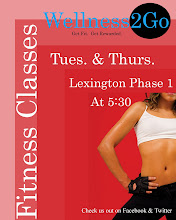
Question of the week: How long should I wait to eat after completing a low and high intensity workout (Like the ones we provide at Lexington Crossing on Tuesday at 5 p.m. and Thursday at 5 p.m.)?
I did my research and I found some helpful tips from www.fitnesstipsforeveryone.com.
· Do not eat anything 15 minutes after a low-intensity workout or 45 minutes to an hour after a high-intensity workout.
· During that time period the muscle replenishes the used up or burnt glycogen that is required for healthy energy utilization by your body
· After completing an intense workout, the metabolism of your body has been heightened. You should not bother your body with extra digestive processes.
Suggestions for what to eat following a workout:
· Water
o Obviously it is important to rehydrate your body!
· Some carbs
· Proteins
o Whey protein shakes are recommended over chicken, tuna or egg whites because the latter take longer to digest.
o Whey protein is a naturally complete protein, meaning that it contains all of the essential amino acids required in the daily diet. It has the ideal combination of amino acids to help improve body composition and enhance athletic performance.
o Whey protein is a rich source of branched chain amino acids (BCAAs), containing the highest known levels of any natural food source. BCAAs are important for athletes since unlike the other essential amino acids, they are metabolized directly into muscle tissue and are the first ones used during periods of exercise and resistance training. Whey protein provides the body with BCAAs to replenish depleted levels and start repairing and rebuilding lean muscle tissue.
o Whey protein is an excellent source of the essential amino acid, leucine. Leucine is important for athletes as it plays a key role in promoting muscle protein synthesis and muscle growth. Research has shown that individuals who exercise benefit from diets high in leucine and have more lean muscle tissue and less body fat compared to individuals whose diet contains lower levels of leucine. Whey protein isolate has approximately 50% more leucine than soy protein isolate.
o Whey protein is a soluble, easy to digest protein and is efficiently absorbed into the body. It is often referred to as a "fast" protein for its ability to quickly provide nourishment to muscles.
o Whey protein helps athletes maintain a healthy immune system by increasing the levels of glutathione in the body. Glutathione is an anti-oxidant required for a healthy immune system and exercise and resistance training may reduce glutathione levels. Whey protein helps keep athletes healthy and strong to perform their best. (Information on the benefits of whey protein were provided by the Whey Protein Institute.)
· No fats whatsoever!!!! They slow down digestion. Step away from the sweets!