Showing posts with label workout. Show all posts

Thursday, July 23, 2009

Now walk it out....

This post is all about the numerous benefits of walking. I discovered today that I ran out of contacts. Much to my dismay, I am forced to wear my glasses. I like to jog daily with sunglasses so this made it very difficult. I had to wear a hat and I do not loot too fancy in a hat. Also, I found out that running in glasses is very difficult because they bounce so I just walked around campus. As I was pouting and walking, I decided to make walking the focus of my next blog. Enjoy and happy workouts!

If a daily fitness walk could be put in a pill, it would be one of the most popular prescriptions in the world. It has so many health benefits. Walking can reduce the risk of many diseases — from heart attack and stroke to hip fracture and glaucoma. These may sound like claims on a bottle of snake oil, but they're backed by major research. Walking requires no prescription, the risk of side effects is very low, and the benefits are numerous:

Managing your weight. Combined with healthy eating, physical activity is key to any plan for long-lasting weight control. Keeping your weight within healthy limits can lower your risks of type 2 diabetes, heart disease, stroke, cancer, sleep apnea, and osteoarthritis.

Controlling your blood pressure. Physical activity strengthens the heart so it can pump more blood with less effort and with less pressure on the arteries. Staying fit is just as effective as some medications in keeping down blood pressure levels.

Decreasing your risk of heart attack. Exercise such as brisk walking for three hours a week — or just half an hour a day — is associated with a 30% to 40% lower risk of heart disease in women. (Based on the 20-year Nurses' Health Study of 72,000 female nurses.)

Boosting "good" cholesterol – the level of high-density lipoproteins (HDL). Physical activity helps reduce low-density lipoproteins (LDL or "bad" cholesterol) in the blood, which can cause plaque buildup along the artery walls — a major cause of heart attacks.

Lowering your risk of stroke. Regular, moderate exercise equivalent to brisk walking for an hour a day, five days a week, can cut the risk of stroke in half, according to a Harvard study of more than 11,000 men.

Reducing your risk of breast cancer and type 2 diabetes. The Nurses' Health Study also links regular activity to risk reductions for both these diseases. In another study, people at high risk of diabetes cut their risk in half by combining consistent exercise like walking with lower fat intake and a 5% to 7% weight loss.

Avoiding your need for gallstone surgery. Regular walking or other physical activity lowers the risk of needing gallstone surgery by 20% to 31%, found a Harvard study of more than 60,000 women ages 40 to 65.

Protecting against hip fracture. Consistent activity diminishes the risk of hip fracture, concludes a study of more than 30,000 men and women ages 20 to 93.

The list goes on and on. Many other studies indicate a daily brisk walk also can help:

  • Prevent depression, colon cancer, constipation, osteoporosis, and impotence
  • Lengthen lifespan
  • Lower stress levels
  • Relieve arthritis and back pain
  • Strengthen muscles, bones, and joints
  • Improve sleep
  • Elevate overall mood and sense of well-being.

Keep it Steady

A steady routine is the most important factor in getting the most out of your exercise program. Walking for at least 30 minutes a day, 5 or more days a week is recommended.

Use these tips to keep you on track:

  • During your walks, you should be able to maintain a conversation. If you're breathing too lightly, increase your pace. If you can't catch your breath, slow it down.
  • Walk around the local area after lunch or dedicate 15 minutes to walking up and down stairs. Climbing is an excellent way to strengthen your heart.
  • At night, trade a half hour of TV for a brisk stroll around the block. Take a friend with you for company or get the whole family involved.

The Best Medicine

Any amount of walking is good, but for the best health results, set a brisk pace and walk for 30 minutes at least 5 times a week. Be sure to check with your doctor on the level of exercise that's best for you.

Tuesday, July 21, 2009

Stick with it!

It is so great to be back in Gainesville. NYC was a blast, but it's back to the daily grind. I was surprised on my return to find that our workout classes at Lexington Crossing have been receiving a very large turnout. I was very impressed with the dedication of some of the participants so this post is in their honor. I found this article on ehow.com. It explains how one can start and stay committed to a successful fitness routine. Happy workouts!

  1. Step1

    Choosing the right fitness training program is not the only important step of getting in shape - you must also construct your plan realistically so that you can stay fully committed. Anyone can begin a fitness training program after getting clearance from his or her physician, and there are thousands of different programs on the market today; however, the real trick comes in knowing how to achieve the personal fitness goals you have set forth.

  2. Step2

    Determining Your Own Personal Fitness Goals: Most people have a skewed idea of what fitness is exactly. Ask anyone, and they'll most likely envision a skinny model-like woman or a huge man that seems like he just stepped off the stage of a body-building competition. You, too, might think this, but personal physical fitness is something much more specialized and unique. This is where commitment comes into play. When most people think of the term "fitness," it has a broad range of definitions that each of us can apply to our own abilities. Fitness generally has nothing to do with your general weight or body shape. If you eat right and work out regularly, sticking to your individual fitness training program, odds are that you're on the right path.

  3. Step3

    The completion of personal fitness goals is controlled entirely by the mind. You have to want to get in shape. If your mind is not truly committed to the final outcome, your goals will never be met even under the best of circumstances or any obstacles that may impede the process. You, and only you, can control your commitment to fitness and ensure that you meet your personal fitness goals.

  4. Step4

    How to Stay Committed: The biggest challenge of a fitness training program or plan is teaching yourself to stay committed - the fact is that most plans fail because there is an overall lack of drive or inspiration to meet those individualized personal fitness goals. Luckily, you have a few options if you find it impossible to stick to your diet and workout plan. Most people talk about finding or using an exercise buddy, but never actually seek one out. Try finding someone at your gym or fitness center with a similar schedule or convince a friend or colleague to join you on your quest for fitness.

  5. Step5

    Another good way to keep focus is to promise yourself a reward if you meet your personal fitness goals. If you've always wanted a pretty piece of jewelry or a new television set, save up during your commitment challenge and splurge once you've met your planned goal. Promising yourself a reward will help you keep your eyes on something you want.

  6. Step6

    What If Your Fitness Goals Aren't Met?: When personal fitness goals are not met, disillusion and despair begin to set in, and the whole venture seems worthless. You must ultimately revisit your commitment to the fitness training program and process and take a long, hard look at all of the factors that are hindering your program. You might find that your level of commitment was lacking; for instance, knowing when you should have rested more, eaten better and more frequently, or perhaps even turned down that additional serving of alcohol or dessert. Some people might dismiss willpower as just a personality trait, but everyone has the ability to resist.

  7. Step7

    Once you re-examine the flaws of your fitness training program, you'll understand why you're not achieving the personal fitness goals you created. However, you must remember to make goals that are attainable and realistic, and this is where many people slip up in planning an effective fitness training program. Research acceptable weight loss or gain, find cookbooks meant for your diet, and set your schedule for workout times that are manageable.

  8. Step8

    The Bottom Line: Making your fitness training program fully attainable is the biggest part of ensuring commitment. Without realistic personal fitness goals, it is highly doubtful that you will succeed. Examine your routine as it is now and slowly work the new regime into your lifestyle. Once you start your fitness plan and get used to the motions, it soon becomes second nature to live a healthy lifestyle.

  9. Step9

    The bottom line is determining if you are really committed to this fitness venture. If you see getting in shape as just another item in a long list that may or may not be completed, this is probably not the right time to start your fitness training program. Look inside yourself and see if you have what it takes to make this goal a reality.

Friday, July 10, 2009

Never give up! Never surrender!

Ok, so this post hits a little too close to home, but it's fine. As I was browsing the infinite World Wide Web, I found this SPECTACULAR article on Mayoclinic.com. It deals with the barriers we all might come across from time to time during the journey toward "fitness." Enjoy reading and maybe next time you'll reconsider not working out! Happy Workouts and have a great weekend!!!!!!!!!

Ps....next week's posts will be from NYC!!!!! Expect some good ones!!!!!!!!!!


Barrier: I don't have enough time to exercise

Setting aside time to exercise can be a challenge. Use a little creativity to get the most out of your time.

  • Squeeze in a few 10-minute walks throughout the day. If you don't have time for a full workout, don't sweat it. Shorter spurts of exercise spaced throughout the day offer benefits, too.
  • Get up earlier. If your days are packed and the evening hours are just as hectic, get up 30 minutes earlier twice a week to exercise. Once you've adjusted to early-morning workouts, add another day or two to the routine.
  • Claim the back row of the parking lot as your own. Or park a few blocks away and walk quickly to your destination.
  • Rethink your rituals. Your weekly Saturday matinee with the kids or your best friend could be reborn as your weekly Saturday bike ride, rock-climbing lesson or trip to the pool.

Barrier: Exercise is boring

It's natural to grow weary of a repetitive workout day after day, especially when you're going it alone. But exercise doesn't have to be boring.

  • Think of it as an activity. If you choose activities you enjoy, you're more likely to stay interested. Remember, anything that gets you moving counts.
  • Vary the routine. Rotate among several activities — such as walking, swimming and cycling — to keep you on your toes while conditioning different muscle groups.
  • Join forces with friends, relatives, neighbors or co-workers. Enjoy the camaraderie, and offer encouragement to one another when the going gets tough.
  • Check out exercise classes or sports leagues at a recreation center or health club. Learn new skills while getting a great workout.

Barrier: I'm self-conscious about how I look when I exercise

Don't get down on yourself! Remind yourself what a great favor you're doing for your cardiovascular health, or focus on how much stronger you feel after a workout. Praise yourself for improving your stamina and making a commitment to lifelong fitness.

If you're still uncomfortable exercising in the presence of others, go solo at first. Try an exercise video or an activity-oriented video game. Consider investing in a stationary bicycle, treadmill, stair-climbing machine or other piece of home exercise equipment. As you become healthier and more at ease with exercising, your self-confidence is likely to improve as well.

Barrier: I'm too tired to exercise after working all day

No energy to exercise? Without exercise, you'll have no energy. It's a vicious cycle. But breaking the cycle with physical activity is one of the best gifts you can give yourself.

  • Try a morning dose of exercise. Remember the suggestion to get up 30 minutes earlier to exercise? Hop on the treadmill or stationary bicycle while you listen to the radio or watch the morning news. Or step outside for a brisk walk.
  • Make lunchtime count. Keep a pair of walking shoes at your desk, and take a brisk walk during your lunch break.
  • Be prepared. Put workout clothes on top of your dresser, socks and all. Keep a full water bottle in the fridge. Have an exercise video queued up and ready to go when you get home at night.
  • Hit the hay earlier. Running on empty is no way to face a full day. Go to bed earlier to make sure you're getting enough sleep.

Barrier: I'm too lazy to exercise

If the mere thought of a morning jog makes you tired, try these thoughts on for size:

  • Set realistic expectations. If your mental bar is too high, you might give up without even trying. Start with a walk around the block. Don't give up if you feel worn out. Take another walk around the block tomorrow. Keep it up, and eventually you'll no longer feel worn out. That's progress!
  • Work with your nature, not against it. Plan physical activity for times of the day when you tend to feel more energetic — or at least not quite so lazy.
  • Schedule exercise as you would schedule an important meeting or appointment. Block off times for physical activity, and make sure your friends and family are aware of your commitment. Ask for their encouragement and support.

Barrier: I'm not athletic

Natural athletic ability isn't a prerequisite to physical activity. Try something simple, such as a daily walk. Better yet, team up with friends who are in the same boat. Have fun while helping each other work out. Don't worry about becoming a superstar athlete or joining the hard-bodied athletes at the fitness club. Simply focus on the positive changes you're making to your body and mind.

Barrier: I've tried to exercise in the past and failed

Don't throw in the towel! You can't see it when you lower your cholesterol or reduce your risk of diabetes, but that doesn't mean you aren't doing yourself a great favor. Re-evaluate what went wrong, and learn from your mistakes.

  • Pace yourself. Start small and build up to more-intense workouts later, when your body is ready.
  • Set realistic goals. Don't promise yourself you're going to work out for an hour every day, and then get down on yourself when you fall short. Stick with goals you can more easily achieve, such as exercising 20 minutes a day, three days a week for the first month.
  • Remember why you're exercising. Use your personal fitness goals as motivation — and reward yourself as you meet your goals.


Wednesday, July 8, 2009

Pilates...more than meets the eyes

So I have heard a lot about pilates, but I have never taken a class before. I thought it was just a more intense version of yoga. So I did my research and found out there are amazing health benefits to this little ol' thing they call PILATES! I received this information at www.articlebase.com/health. Happy reading and as always...HAPPY WORKOUTS!

1. Makes You into Muscle Man

If want a long, lean look without bulky muscles, but with all the strength. Would you like to build strength and endurance without getting the muscle man look? If so, pilates may be just what you have been searching for.
There's a reason that pilates is the exercise of choice for gymnasts and professional dancers. Most conventional workouts tend to create bulky muscle. Why is this? In most workouts, the emphasis is placed on repetition and building strong muscles.

This causes already-strong (think: big) muscles to get even strong, and thus bigger. Pilates does not rely on frequent repetition, and thus no overgrown muscles. Pilates focuses on the whole body, not just on sections of muscles.

2. Increases the Strength of Stabilizer Muscles

There are many benefits that one can achieve through a proper use of the pilates program. One of the most significant points of the pilates program is it's ability to increase the strength of stabilizer muscles that may not commonly be worked out in a standard exercise program.

Also, since pilates stresses the use of graceful and fluid movements, it can be a great way to get a better sense of the kinesthetics ofyour body. The sense of body that you can achieve through pilates is quite significant, and many find that they are better able to balance themselves regardless of the position that they are in.

3. A Mind-Body Workout That Strengthens Your Whole Body

Another one of the benefits of Pilates is that it engages the mind and enhances body awareness. Like yoga, tai chi, and Asian martial arts, Pilates is not just a workout for your body. Joseph H. Pilates studied yoga, martial arts, and other ancient mind-body activities and included a strong philosophical foundation into the practice of Pilates.

Pilates not only helps tone your body, but your mind and spirit as well. The smooth, precise and flowing movements of Pilates are designed to make you more mindful of your body.

Breath movement is also emphasized to put you in touch with how breath moves through your body. Pilates has been demonstrated to reduce stress, anxiety, and helps lift depression. The mind-body connection is fundamental to the study and practice of pilates.

4. Pilates Strengthens Your Core like No Other Exercise

Another one of the benefits of Pilates is that the increased amount of strength that one can achieve in the 'core' of the body. The term core refers to the muscles in and around the area of the abdominal muscles and the back.
Proper breathing control is also stressed in pilates, adding to the numerous list of benefits that one can attain through regular use of the exercise program.

5. Prevents You from Future Injuries

Pilates strengthens your body and helps prevent future injuries. Pilates helps to condition the whole body, not just certain muscles. This helps balance the muscle and strength of the body. Since no set of muscles is ever over or under trained, there is less risk for injury. The body becomes more fluid and supple, protecting against injury.

6. Helps You Become Efficient With Your Body

Last, but not the least one of the benefits of Pilates is that it teaches you how to become efficient with your body. Very few exercises can help your body become more efficient in its movement.
Why is efficiency so important? Being efficient means that your body moves in a way, that is smoother, safer, and less prone to injury. By practicing pilates on a regular basis, you can train your body more to move in a much safer and more efficient manner.

Other Benefits of Pilates
Tone and build long, lean muscles without bulk.
Reduce stress, relieve tension, and boost energy through deep stretching.
Restore postural alignment.
Create a stronger, more flexible spine.
Increase joint range of motion.
Improve circulation.
Heighten neuromuscular coordination.
Offer relief from back pain and joint stress.
Correct over-training of muscle groups which can lead to stress and injury.
Enhance mobility, agility and stamina.
Compliment sports training and develop functional fitness for daily life activity.
Improve the way your body looks and feels.

Monday, July 6, 2009

Jump start your old routine! Shock it real good!

Has your workout gotten a little boring?? Well if it has then it is time to perk up and try something new or add some intensity. I found this amazing article on how to add some pep to your workout routine. It came from http://www.mirror.co.uk/opinion/blogs/.


Try it for yourself! Happy workouts!


Equipment

A treadmill and a set of dumbbells you feel challenged with when doing biceps curls for a set of 15 reps. Most women can do 3-5kgs and most men can do 6-10kgs.

Routine

Jump on the treadmill for five minutes at a pace which is challenging. Stop after five minutes. Pick up the dumbbells and do these exercises in order with no rest in-between.

Step-ups on the side of the treadmill with dumbbells 10 reps each leg
Squats with dumbbells 15 reps
Lunges with dumbbells 10 reps each leg
Biceps curl with dumbbells 15 reps
Shoulder press with dumbbells 10 reps
Bent over rows with dumbbells 15 reps
Triceps dips on the side of the treadmill 15 reps
Press-ups next to the treadmill 15 reps
Into a plank for 30 seconds

Jump back on the treadmill and knock out another five minutes at a pace that challenges you. Repeat the whole workout five times. The whole workout will take you about 45 minutes.

If you are out doors with your resistance band you will simply find a route to do cardio' that starts and finishes at a park bench and takes five minutes to complete. Then simply apply the same circuit as above. Of course you will have to do the leg exercises without the band so do an extra five reps to increase intensity.


Thursday, June 11, 2009

The No Nos in Weight Loss

Today's post is about the mistakes we all make when trying to get into shape. I retrieved these 5 weight loss mistakes from examiner.com. 

1. Not lifting weights. Using weights is the number one mode of exercise to burn body fat!

2. Walking. It's a good start but it just isn't enough, 

3. Not committing your self enough or going hard enough at the gym. Stay committed. Push yourself. 

4. Doing boring cardio. Now don't get me wrong, I love just listening to my Lady Gaga or watching the Cash Cab while doing the elliptical machine but if you want to burn fat you need to add some high intensity interval training. Plus, varying your workout routine keeps it interesting, 

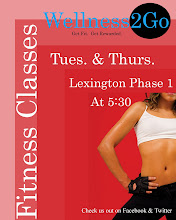
5. Not looking for someone to help you. Consult a personal trainer or fitness expert if you have any questions. Try attending the Wellness2Go fitness classes at Lexington Crossing on Tuesdays and Thursdays at 5 p.m. Ed Buckley leads the classes and is an expert on fitness. He would be happy to answer any of your questions!!!

Happy workouts! 

Sunday, June 7, 2009

Sore Muscles...

This week's blog is all about those pesky sore muscles you get the day after a workout. Let's say you attend this week's fitness classes at Lexington Crossing on Tuesday and Thursday as 5 p.m. and you want to know how to prevent and treat sore muscles. Well, I found some very helpful information on eHow.com 

1. Apply an ice pack for 20 minutes to any area that hurts. Repeat this every hour until the pain subsides.

2. STRETCH before and after your workout to avoid sore muscles. If your muscles are already sore, stretch the sore area gently to rid your body of lactic acid, which contributes to the pain.

3. Walk 15 to 30 minutes at least once a day to increase circulation throughout your body. This will also help deliver much-needed oxygen to the sore muscles.

4. Stay hydrated. Drink a minimum of eight glasses (64 oz.) of water daily - more if you're active - to hydrate your body. Many physical problems, including sore muscles, can be attributed to poor hydration. Remember to drink plenty of water. If you are doing very vigorous exercise for a long period of time, you may want to consider drinking water that has been fortified with electrolytes. 

5. Avoid strenuous activity as long as you're in pain.

A personal tip. Keep working out. You might be sore the first few times, but eventually you get used to it!!! 

Sunday, May 31, 2009

This week’s entry is all about food!            

Question of the week: How long should I wait to eat after completing a low and high intensity workout (Like the ones we provide at Lexington Crossing on Tuesday at 5 p.m. and Thursday at 5 p.m.)?

I did my research and I found some helpful tips from www.fitnesstipsforeveryone.com.

·      Do not eat anything 15 minutes after a low-intensity workout or 45 minutes to an hour after a high-intensity workout.

·      During that time period the muscle replenishes the used up or burnt glycogen that is required for healthy energy utilization by your body

·      After completing an intense workout, the metabolism of your body has been heightened. You should not bother your body with extra digestive processes.

Suggestions for what to eat following a workout:

·      Water

o   Obviously it is important to rehydrate your body!

·      Some carbs

·      Proteins

o   Whey protein shakes are recommended over chicken, tuna or egg whites because the latter take longer to digest.

o   Whey protein is a naturally complete protein, meaning that it contains all of the essential amino acids required in the daily diet. It has the ideal combination of amino acids to help improve body composition and enhance athletic performance.

o   Whey protein is a rich source of branched chain amino acids (BCAAs), containing the highest known levels of any natural food source. BCAAs are important for athletes since unlike the other essential amino acids, they are metabolized directly into muscle tissue and are the first ones used during periods of exercise and resistance training. Whey protein provides the body with BCAAs to replenish depleted levels and start repairing and rebuilding lean muscle tissue.

o   Whey protein is an excellent source of the essential amino acid, leucine. Leucine is important for athletes as it plays a key role in promoting muscle protein synthesis and muscle growth. Research has shown that individuals who exercise benefit from diets high in leucine and have more lean muscle tissue and less body fat compared to individuals whose diet contains lower levels of leucine. Whey protein isolate has approximately 50% more leucine than soy protein isolate.

o   Whey protein is a soluble, easy to digest protein and is efficiently absorbed into the body. It is often referred to as a "fast" protein for its ability to quickly provide nourishment to muscles.

o   Whey protein helps athletes maintain a healthy immune system by increasing the levels of glutathione in the body. Glutathione is an anti-oxidant required for a healthy immune system and exercise and resistance training may reduce glutathione levels. Whey protein helps keep athletes healthy and strong to perform their best. (Information on the benefits of whey protein were provided by the Whey Protein Institute.)

·      No fats whatsoever!!!! They slow down digestion. Step away from the sweets!